
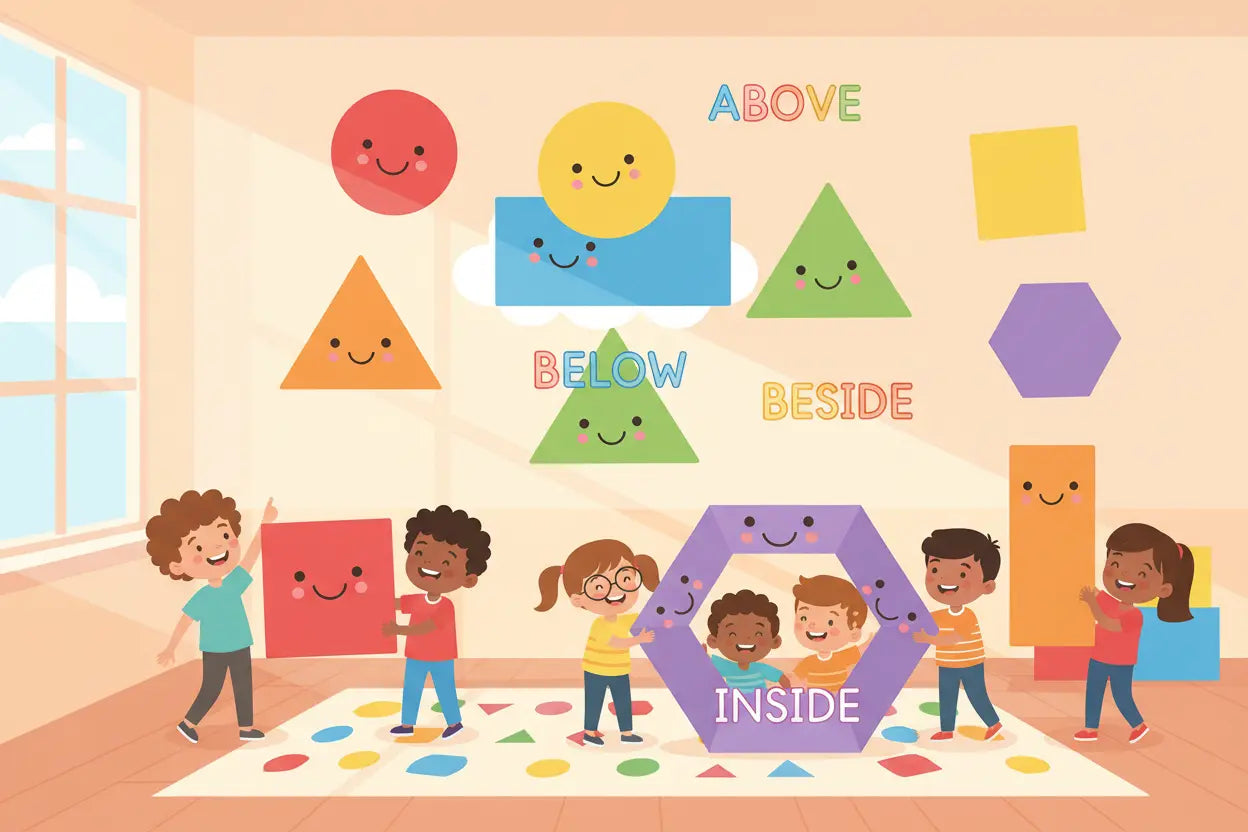
Shapes are already part of your child’s day. The plate at breakfast is round, a favorite book may be rectangular, and the blocks on the floor can have squares, triangles, and circles. Exploring these familiar objects is one of the simplest ways to introduce shapes for preschoolers at home.
Quick answer: how can preschoolers learn shapes?
Begin with shapes your child can see and touch. Name the shape, notice its features, and use spatial words to describe where it is. A short conversation about a square window or a ball under the table can make early math feel relevant and easy to revisit.
- Look for shapes in familiar rooms.
- Compare straight sides, curved edges, and corners.
- Use words such as above, below, beside, inside, and between.
- Keep each learning moment short and relaxed.
Start with familiar preschool shapes
Circles, squares, triangles, and rectangles are a helpful starting point. Instead of introducing every shape at once, choose one or two and look for different examples together.
A clock and a plate may both be circles, even though they differ in size and purpose. A door and a book may both be rectangles. These comparisons help children notice that the same shape can appear in many forms.
Talk about what makes each shape different
Learning about shapes involves more than remembering their names. Invite your child to notice whether an edge is straight or curved and count the sides or corners together.
You might say, “This triangle has three straight sides. Can you find another shape with three sides?” Simple observations introduce early geometry without making the moment feel like a test.
Use spatial words during everyday routines
Spatial language explains where objects are and how they relate to one another. Words such as inside, outside, above, below, beside, behind, near, and far can be woven into ordinary conversations.
Try asking your child to place a square block beside a circle, put a triangle inside a box, or find the book under the chair. Stanford’s Development and Research in Early Math Education network also recommends moving beyond shape labels to discuss features, position, size, and direction in its guide to spatial reasoning and math talk.
Try a shape hunt around your home
Choose one room and see how many different shapes you can find. Look at windows, cushions, picture frames, tiles, bowls, and other familiar objects.
Encourage your child to explain each choice. Asking, “What did you notice?” creates more conversation than simply asking for the correct answer.
Sort and build with different shapes
Gather blocks, paper cutouts, lids, or other safe household objects. Sort them by shape, size, number of corners, or whether their edges are straight or curved.
Building with shape pieces also gives children a chance to turn, stack, and reposition objects. Handling and arranging smaller pieces can support fine motor skills while keeping the focus on shape recognition and spatial language.
Read a shape book together
A picture or shape book can help children notice geometry within illustrations. Pause to find repeated shapes, compare their sizes, or describe where one object sits in relation to another.
You do not need to ask a question on every page. A simple observation such as, “That little circle is inside the larger one,” introduces useful language without interrupting the story.
Create a simple shape bingo search
Draw a small grid containing a circle, square, triangle, and rectangle. Your child can mark each shape after finding a matching object around the home.
For another version of shape bingo, add clues such as “find something round above you” or “find a rectangle beside the door.” This combines shape recognition with positional words.
Follow your child’s interests
If your child enjoys vehicles, look for circles in wheels and rectangles in windows. If animals are the current favorite, notice shapes in picture books or create simple animals from paper shapes.
There is no need to correct every answer immediately. If your child calls an oval a circle, compare the two and talk about what looks similar or different.
Build shape learning into early math at home
Recognizing and comparing shapes is an early math skill that connects naturally with counting, sorting, patterns, and measurement. Our guide to preschool math at home shares more ways to explore these ideas during everyday family routines.
Explore shapes through projected lessons
Ozmotic Learning gives families another way to revisit shapes, patterns, and early numbers through guided, projection-based lessons. You can browse the mathematics lessons or explore the wider Ozmotic Learning content library to find a topic that suits your child’s current interests.
Keep shape learning simple and consistent
You do not need a formal lesson plan to introduce shapes for preschoolers. Begin with what is already around you, add a few useful spatial words, and let the conversation develop naturally.
For a calm way to continue exploring early math together, discover how the Ozmotic Learning projection-based learning experience can become part of your family’s learning-at-home routine.
Share:
Counting for Preschoolers: How to Build Number Sense Through Everyday Routines
Off to Kindergarten - What to Review Before School Starts: 5 Learning Areas to Explore at Home