
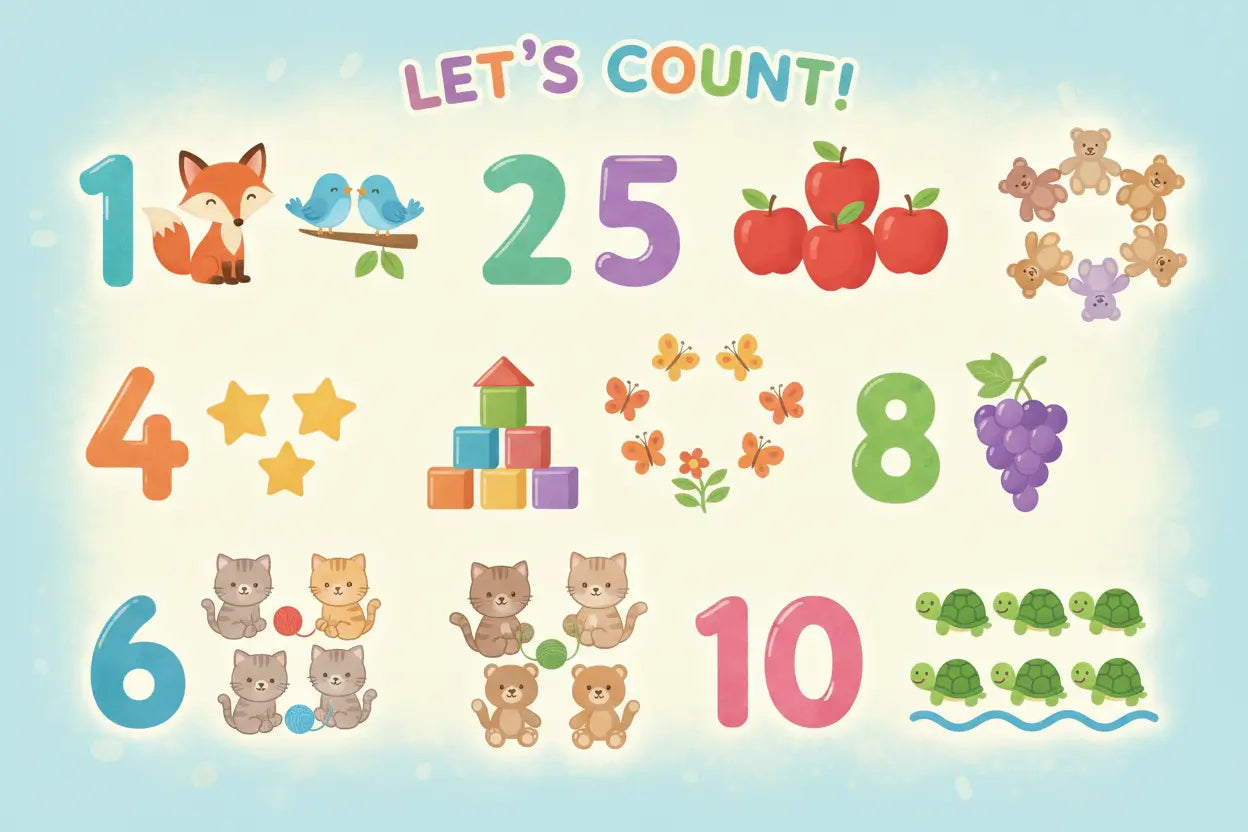
Counting often begins in the smallest family moments. One sock, two shoes, three strawberries, or four steps to the front door can introduce numbers in a way that feels natural and useful.
When you bring counting into routines your child already knows, there is no need to set up a formal lesson. You are simply helping number words connect with real objects, amounts, and experiences. This is a practical way to support counting for preschoolers throughout the day.
How can you help a preschooler learn to count?
Start with a small group of familiar objects. Touch or move each item as you say its number, then repeat the total when you reach the end: “One, two, three. We have three cups.” This helps your child connect the counting sequence with how many objects are actually there.
- Begin with small groups of familiar objects.
- Say one number for each item.
- Repeat the total after counting.
- Compare groups using more, fewer, and the same.
- Keep the conversation relaxed and responsive.
What is number sense?
Number sense is an understanding of numbers and quantities. It includes noticing that five is more than three, recognizing a small group without counting every item, and understanding that a number represents a particular amount.
These ideas develop gradually. Your child may confidently recite numbers before being able to count a group accurately. Both are useful counting skills, but they are not quite the same thing.
Reciting numbers is different from counting objects
Familiar rhymes such as “one, two, buckle my shoe” and “one potato, two potato” can help children become comfortable with number order. Counting objects adds another layer because each number word must be matched with one item.
This is known as one-to-one correspondence. Moving each object into a new group can make the process easier to follow. Your child might move four spoons across the table, for example, saying one number as each spoon is moved.
The Stanford University DREME Network explains that early counting also involves understanding number order, quantities, and the total represented by the final number. Its guide to the principles behind early counting offers a helpful explanation for parents and educators.
Find counting moments in the day you already have
You may already be creating more early math moments than you realize. Counting strawberries into a bowl, buttons on a shirt, shoes by the door, or books going back onto a shelf gives number words a real purpose without adding another lesson to the day.
Mealtimes are especially helpful because counting can solve a familiar little problem: “There are four of us. Do we have four forks?” You can also notice which plate has more apple slices, which has fewer, or whether both have the same number.
Movement and sound give you other ways to explore quantities. Count steps as you walk upstairs, claps during a song, or gentle taps on the table. Because there is nothing to hold or move, your child has an opportunity to listen and keep track in a different way.
There is no need to count everything you see. Choosing one small moment keeps counting enjoyable and allows the rest of your routine to carry on as usual.
Help written numbers feel familiar
Number recognition, sometimes called numeral identification, means connecting a written symbol such as 3 with its number name and quantity. Calendars, house numbers, numbered drawers, and pages in a counting book can all help written numbers become familiar.
You might point to the number 3 and then count three pictured birds together. This creates a simple connection between the written numeral, the spoken number, and the amount it represents.
Ask “how many?” after counting
Once you have counted a group, ask, “How many are there altogether?” If your child begins counting again, that is completely fine. With time and repetition, the final number starts to represent the total amount. This understanding is called cardinality.
A warm reminder can help make that connection: “You counted six shells, so there are six altogether.”
See what happens when the objects move
Place four objects in a line and count them together. Then arrange the same objects in a circle or spread them farther apart. Although the group looks different, there are still four objects.
This is a useful early number-s-sense idea: changing the space between objects does not change how many there are. There is no need to explain the rule formally. Simply noticing the result together is enough.
Compare more, fewer, and the same
Counting becomes even more useful when it helps children compare groups. You might place three blocks in one group and five in another, then wonder together which group has more.
Begin with amounts that look noticeably different. Later, you can compare groups that are closer in size or create two equal groups and introduce the phrase the same number.
Read a counting book together
A familiar counting book can bring number words, written numerals, pictures, and quantities together. Pause occasionally to count the pictured objects, pointing to each one as you go.
You do not need to turn every page into a question. Sometimes a simple observation such as, “I can see three little birds,” is enough to draw attention to the number while keeping storytime warm and relaxed.
Follow what already interests your child
If animals are a favorite, count animals in a book. If your child loves vehicles, count wheels, doors, or cars passing on a walk. Using familiar interests makes it easier to return to counting without the moment feeling forced.
It is also normal for a child to skip a number, count one object twice, or lose track along the way. You can gently count the group together and try again another time. Early learning does not need to become a test.
Connect counting with early math at home
Counting is one part of a wider early math foundation that also includes comparing, sorting, shapes, patterns, and spatial language. Our guide to preschool math at home shares more ways to explore these ideas during everyday family routines.
Continue exploring numbers together
Ozmotic Learning gives families a calm way to revisit counting, quantities, number recognition, and patterns through guided, projection-based lessons. You can browse the Ozmotic Learning mathematics lessons or explore the wider learning content library to find a topic that suits your child’s interests.
You do not need to count during every routine or correct every mistake. Start with the little moments already happening around you and let the conversation develop from there. Those ordinary cups, shoes, steps, and strawberries offer plenty to explore together.
Share:
Number Recognition Activities for Preschoolers: Connecting Numbers and Amounts
Shapes for Preschoolers: Simple Ways to Explore Shapes and Spatial Words