
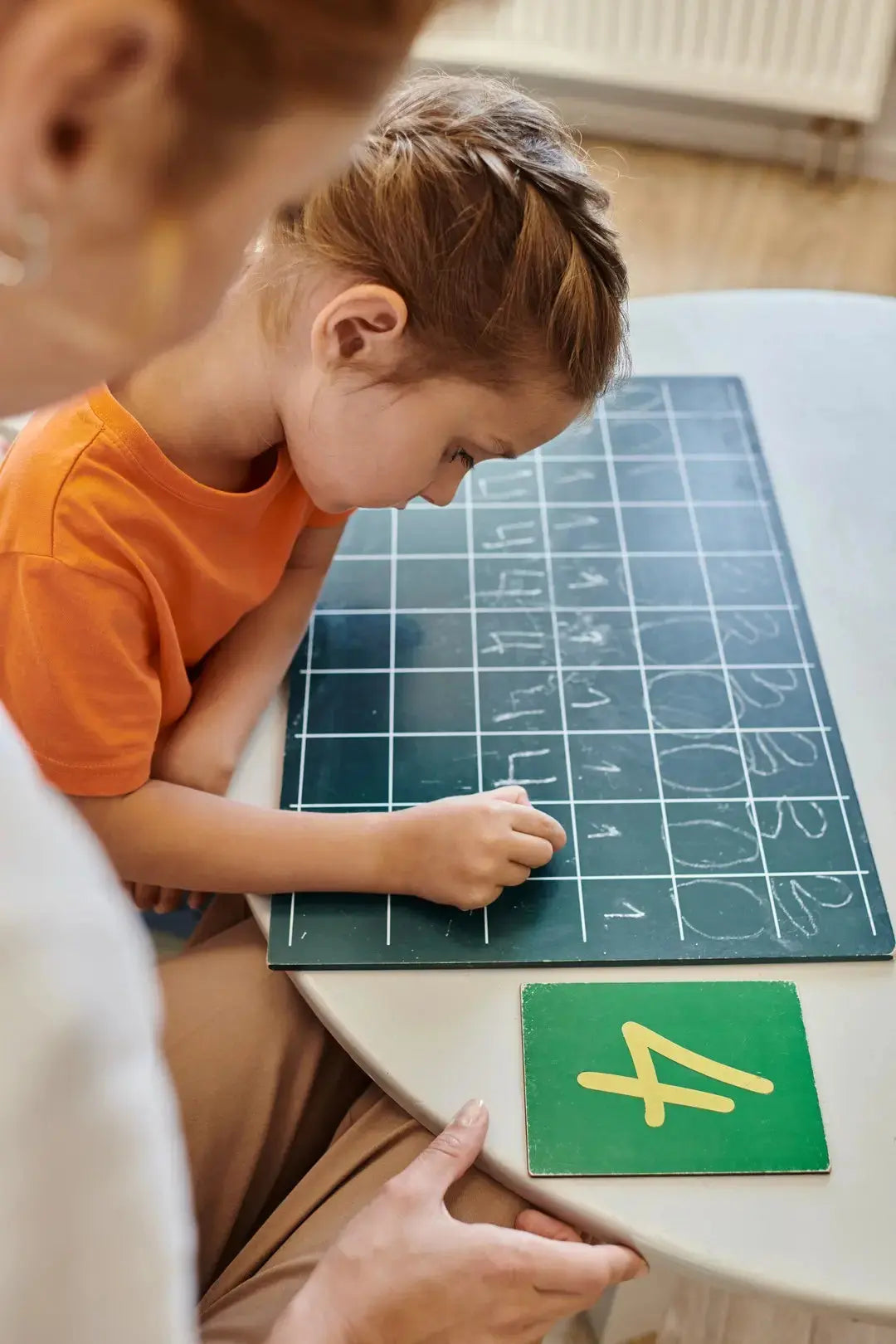
As a parent of young children, you have probably noticed moments when your preschooler asks, “What’s that?” or lines up blocks, books, or soft animals. These everyday curiosities are natural entry points for preschool math at home.
You do not need fancy workbooks or a classroom setup. Your living room, kitchen, backyard, and a few minutes of calm interaction can introduce numbers, shapes, order, and quantity.
At Ozmotic Learning, we started this journey with our own children. We wanted peaceful bedtime routines that combined calm repetition with gentle learning: snacks, brushing teeth, a book, Ozmotic Learning projecting simple math visuals onto the ceiling, and then sleep. In our family, this consistent, low-pressure exposure helped numbers, shapes, and patterns feel familiar and exciting rather than overwhelming.
Early math is not about pushing academics too soon. It is about nurturing natural curiosity and helping numbers, shapes, and patterns feel familiar. Research has established a strong association between early mathematics proficiency and later mathematics and reading achievement, although this does not guarantee an individual outcome. Read the research examining early mathematics and later learning outcomes.
In this article: Simple ways to introduce counting, sorting, shapes, and patterns at home, plus a calm projection-based review routine.
Why Preschool Math at Home Matters
Young children naturally notice quantity, space, shape, and order. A child may see that one plate has more crackers, that a round lid rolls, or that two socks match before knowing the formal math words.
Home learning moments can introduce quantity, spatial language, comparing, sorting, and pattern recognition. Head Start guidance on early mathematics also encourages more confident families to discuss mathematical ideas during everyday routines.
Early Math Activities in Everyday Life
Math is more than counting numbers in order. These early ideas include recognizing quantity, comparing groups, sorting objects, naming shapes, noticing patterns, and using words such as under, beside, behind, and next.
These ideas appear throughout family routines. Setting the table introduces one item for each person. Packing away books can involve sorting by size.
Simple examples can help parents bring math into familiar routines without creating a formal lesson.
Understanding Quantity as a Starting Point
This early understanding connects numbers with real quantities. It includes recognizing small groups, comparing amounts, and knowing that the last number counted tells how many objects are present.
Ask, “Do we have enough cups for everyone?” or “Which bowl has fewer strawberries?” Questions linked to visible objects connect number words to real amounts.
Simple Ways to Practice Preschool Math
Use one idea at a time and let your child respond in their own way.
Count During the Daily Routine
While preparing snacks, count strawberries, crackers, or fruit slices. Place one item at a time on the plate and ask, “How many do we have now?” or “How many more do we need?”
You can also count steps, match socks, set out spoons, or count blocks while building a tower. For a number hunt, place number cards around a room and name each one along the way.
Sort and Compare Stuffed Animals
Sort a small group by size, color, or type. Count each group, compare which has more, and arrange them from smallest to largest.
Create a repeating sequence, such as large-small-large-small, and ask what comes next. This connects sorting, comparing, counting, and pattern recognition.
Explore Shapes Around the Home
Shapes help children describe objects and notice how things fit together. Search for circles in plates and wheels, rectangles in books and doors, squares in windows, and triangles in roof lines.
Describe what you notice: “This plate is round and has no corners,” or “This book has four sides.” Connecting shape words to familiar objects makes them easier to recognize.
Build Essential Math Skills Through Shape Talk
Use blocks, pillows, boxes, or recyclable containers to build and compare forms. Ask how many sides a shape has, whether two pieces are the same, or which piece fits into an open space.
Draw shapes on paper or with sidewalk chalk, then trace the edges while naming the sides and corners.
Words such as above, below, inside, outside, and beside also introduce spatial math concepts.
Notice and Extend Patterns
Patterns support observation, prediction, and early problem-solving. Begin with two colors or objects, such as red-blue-red-blue, and ask, “What comes next?”
When that sequence feels familiar, try red-blue-yellow-red-blue-yellow. There is no need to rush; repeating the simpler example is also useful.
Connect Patterns to Early Math Concepts
Use blocks, beads, snacks, socks, leaves, or rocks to create sequences. Notice patterns in clothing, music, or family routines, such as bath, pajamas, book, and bedtime.
Movement patterns bring the idea into the body: clap, stomp, clap, stomp. Pause and invite your child to predict what follows.
Patterns can be visual, physical, musical, or part of a routine.
How Ozmotic Learning Fits Into the Routine
Our favorite way to revisit these ideas is during the wind-down. After the usual routine, Ozmotic Learning can project calm counting sequences, shape visuals, or pattern lessons onto a wall or ceiling.
Research with children suggests that learning spread over time can support memory and generalization, while sleep soon after learning may support retention. Although these studies did not test Ozmotic Learning or preschool math specifically, they support revisiting familiar concepts before sleep.
Families can explore Ozmotic Learning’s mathematics content and explore the full learning content library to view projected lessons across mathematics and other learning areas.
As a projection-based learning tool, Ozmotic Learning can become one calm part of a wider family routine while everyday conversations keep early math meaningful.
Tips for Building a Strong Foundation
- Keep each learning moment short, positive, and manageable.
- Follow your child’s interest and notice effort.
- Use words such as more, less, same, next, side, under, and between.
- Rotate examples across counting, shapes, comparing, and patterns.
- Notice subtle progress, such as sorting books or identifying a circle.
Avoid pressure or drills. Calm repetition gives children room to observe, respond, and revisit an idea.
A solid foundation grows through short conversations and familiar examples.
Frequently Asked Questions
What Early Math Skills Matter Most for Preschoolers?
Useful early math skills may include counting, number sense, comparing, sorting, shape recognition, pattern recognition, and spatial language. Children develop these ideas at different rates, so regular exposure matters more than a fixed schedule.
How Can Families Build Number Sense at Home?
Use familiar moments such as sharing snacks, setting the table, counting steps, or comparing groups. Ask which group has more or less and connect number words to quantities your child can see.
What Can a Simple Preschool Math Routine Look Like?
Choose one brief example, such as counting fruit, spotting shapes, or sorting household objects, then finish with a calm projected lesson that revisits the idea. A few focused minutes can fit into an existing family routine.
Preschool math at home is about connection and curiosity more than mastery. By weaving numbers, shapes, and patterns into familiar routines, you give your child repeatable ways to discuss early concepts and build a foundation for continued learning.
Share:
Why Repetition Helps Children Revisit Ideas During Summer
Unlocking Early Math: Shapes and Patterns for Preschoolers