
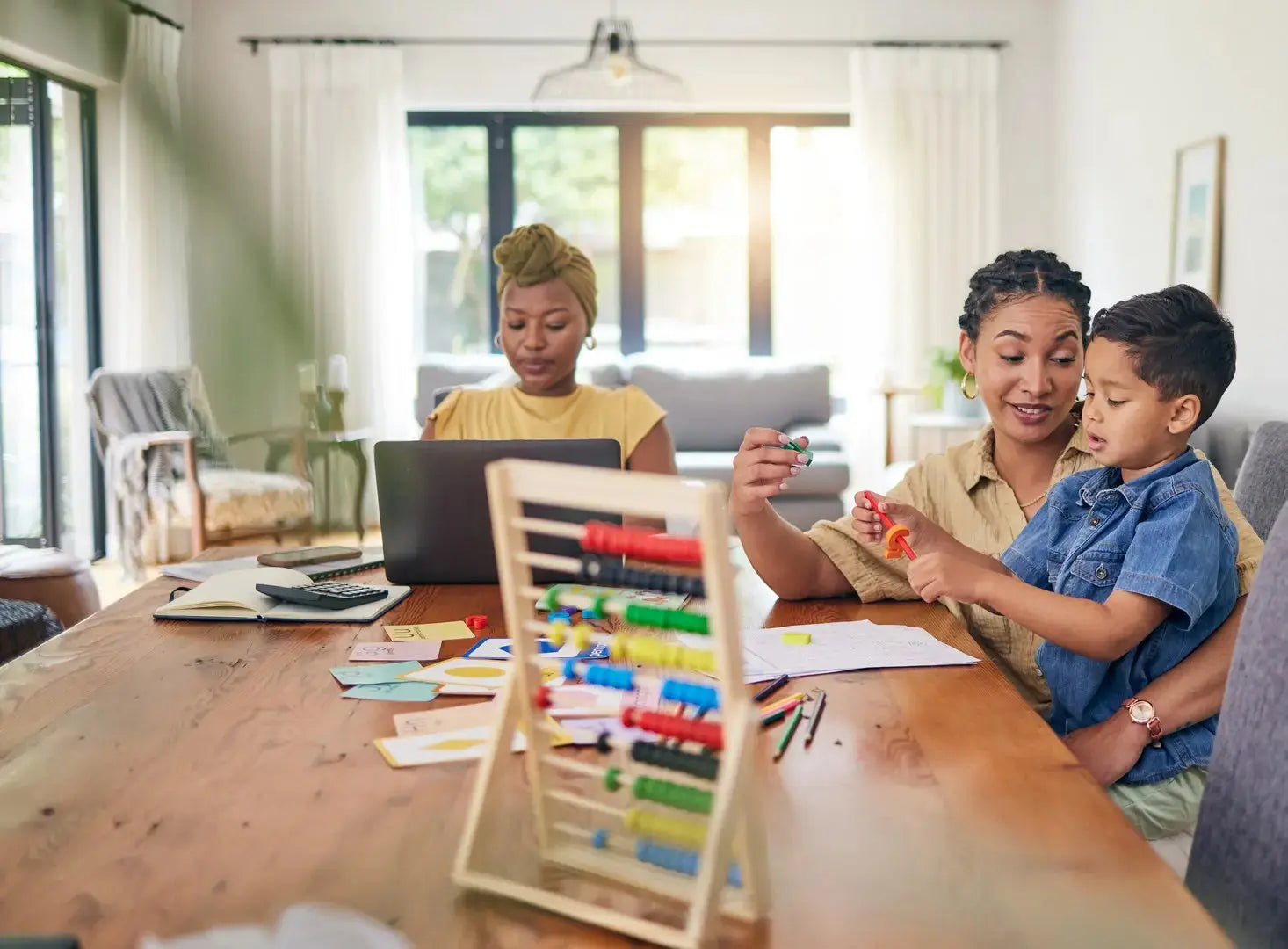
Picture this: your preschooler notices the stripes on a blanket, then arranges red and blue blocks in the same order. These small moments are often where patterns for preschoolers begin: with something familiar, a repeated sequence, and the excitement of working out what comes next.
When we began building Ozmotic Learning around our own family routines, we did not want bedtime to feel like another formal lesson. We wanted a calm moment where children could notice shapes, revisit a simple sequence through projection, and explain what they saw.
Why Shapes and Patterns for Preschoolers Matter in Early Math
Shape recognition and pattern recognition are related, but they ask children to notice different things. Naming a triangle is shape recognition. Seeing triangle-circle-triangle-circle and identifying what follows is pattern recognition.
Research summarized by The Education Hub reports that early patterning skills are associated with current and later mathematical competence, including number, algebra, and geometry. Read the research on patterns in early mathematical understanding.
A study of repeating-pattern and spatial skills found that both predicted children’s math knowledge at assessment and seven months later. This supports pattern recognition as part of early mathematics without turning it into a guaranteed outcome.
Pattern Recognition and Early Math Thinking
A pattern has a rule that repeats. In red-blue-red-blue, the repeating unit is red-blue. Children may first copy a pattern, then continue it, describe it, and create a new sequence using the same rule.
How to Teach Patterns to Preschoolers
Parents often ask how to teach patterns without making the moment complicated. Start with two clearly different objects and repeat them several times. Point to each object as you name the sequence, then pause before the final space.
When we used simple sequences in our own routines, that pause mattered. It gave our children room to look, think, and respond rather than simply hearing the answer.
Make Patterns with Everyday Objects
You can make patterns with socks, spoons, crackers, leaves, or blocks. Try spoon-fork-spoon-fork, then change the objects while keeping the same repeating structure.
Start with a Simple Color Pattern
An AB color pattern is an accessible starting point: red-yellow-red-yellow. Ask, “What comes next?” and let your child choose the next color.
When the first color pattern feels familiar, move to an AAB sequence such as red-red-yellow, or an ABC sequence such as red-yellow-blue. Revisit the same sequence before adding complexity.
You can also create a broken color pattern by placing one object incorrectly and inviting your child to find what does not follow the rule.
Use Pattern Cards and Pattern Blocks
Pattern cards give children a visible sequence to copy, extend, or describe. Start with short pattern cards that show a clear AB rule, then remove the final object and ask what belongs there.
These geometric pieces add shape and position. Children can copy a row, continue the sequence, or build the same rule with different shapes.
Create a Simple Math Center at Home
A small math center can be a tray or basket with a few pattern cards, colored counters, blocks, and household objects. Rotate the materials while leaving one familiar example available for repetition.
Teaching Patterns to Preschoolers Through Calm Routines
Patterns already exist in family life. A bedtime routine has an order. A song has a repeating rhythm. A row of tiles may repeat the same colors or shapes. Naming these sequences connects mathematical language with something children already know.
During the evening wind-down, try clapping a short rhythm, arranging a sequence on the bed, or projecting a gentle shape pattern and pausing before the next image. The aim is a shared moment of noticing, not a quiz.
Research on children’s word learning suggests that sleep shortly after exposure may support retention. It did not test pattern lessons or Ozmotic Learning, so it does not prove that bedtime pattern practice is superior.
How Ozmotic Learning Supports Shape and Pattern Lessons
We did not create Ozmotic Learning to turn bedtime into school. We created it to give families a calmer way to revisit letters, numbers, shapes, and curiosity through projection.
Parents can choose a projected sequence, pause for a prediction, and revisit the idea over several evenings. Explore our mathematics learning content for number, shape, and sequence-focused lessons.
You can also explore the full learning content library to see how pattern lessons sit alongside reading readiness, science, languages, and other topics.
For us, the most valuable moment is not a perfect answer. It is when a child looks closely, notices the repeat, and wants to explain it. Families interested in adding this approach to their routine can explore Ozmotic Learning.
Practical Tips for Consistent Pattern Practice
- Begin with one clear repeating unit.
- Ask your child to copy before asking them to continue.
- Use open prompts such as, “What do you notice?”
- Repeat the same rule with different objects.
- Stop while the moment is still calm and engaging.
Avoid correcting too quickly. Give your child time to look across the full sequence. If the answer is unexpected, ask them to explain the rule they noticed.
Frequently Asked Questions
What Patterns Should Preschoolers Learn First?
Simple repeating AB patterns are a useful starting point. Try red-blue-red-blue or spoon-fork-spoon-fork. Keep the sequence short, name each part, and ask what should come next.
How Do You Introduce a Color Pattern?
Choose two clearly different colors and repeat them several times. Point to each color as you name the color pattern, then leave one space open and invite your child to complete it.
How Can Families Use Pattern Cards?
Pattern cards can guide copying, continuing, and describing. Begin with a short sequence, place matching objects beneath the pictures, and ask your child to identify the part that repeats.
What Are Pattern Blocks Used For?
These geometric pieces can be used to explore shapes, matching, position, and repeating rules. Children can copy a visible sequence, extend it, or create a new arrangement using the same pattern structure.
For our family, patterns for preschoolers were never about pushing toward the next academic milestone. They were about making space for curiosity, conversation, and the proud moment when a child sees the rule before the next shape appears.
Share:
Preschool Math at Home: Simple Ways to Support Numbers, Shapes, and Patterns
Rhyming Activities for Preschoolers: 10 Simple Games at Home