
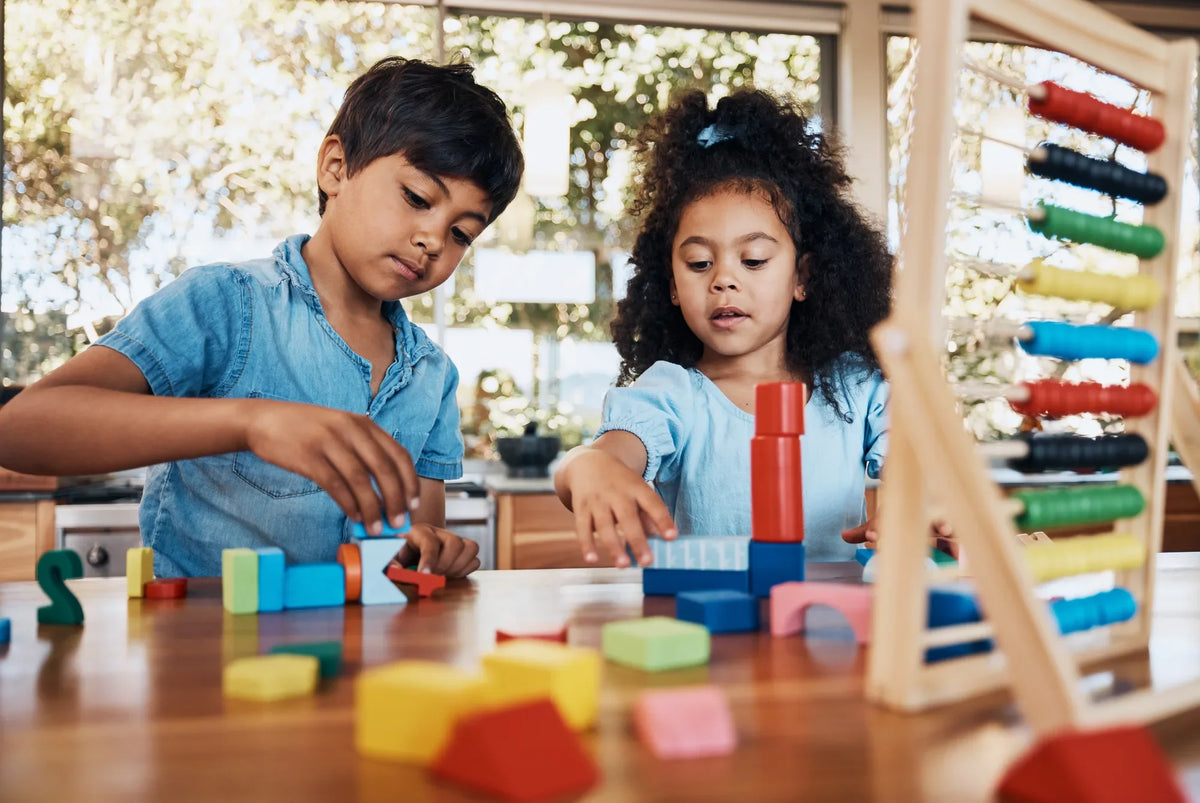
Measurement begins well before a child needs a ruler. Young children notice that one block is taller, one cup holds more, or one bag feels heavier than another.
Measurement for preschoolers is about making those comparisons more precise. Children begin by comparing length, height, weight, and capacity, then gradually learn that consistent units help describe the result.
Quick answer: what does measurement mean in early math?
Early measurement means comparing an attribute such as length, height, weight, or capacity and describing what is different.
A child might decide which ribbon is longer, which tower is taller, whether an object feels heavy or light, or which container holds more.
Stanford DREME guidance on measurement at home explains that children can explore measurement before they understand formal units of measurement.
Start by comparing different sizes
Before measuring with tools, invite children to notice different sizes.
Place two objects side by side and ask which is longer. Stack two towers and compare their heights. Hold two safe objects and ask which feels heavier.
Words such as longer, shorter, taller, heavier, lighter, more, and less make the comparison easier to describe.
How to measure the length of everyday objects
If you are wondering how to teach measurement, begin with comparison before introducing formal tools.
To measure the length of an object, begin with something familiar.
Place identical blocks end to end beside a book. Count the blocks and say, “This book is six blocks long.”
You can also use paper clips or identical craft sticks. Use units of the same size and place them without large gaps.
Then compare the length of two objects measured with the same unit.

Why non-standard units are useful
Non-standard units are familiar objects used for measuring instead of centimeters, inches, or another standard unit.
Blocks, paper clips, footsteps, and hand lengths can all work. Using non-standard units keeps the focus on the measurement idea before children need to read formal tools.
Ask what happens if there are gaps between the units or if the units are different sizes. These questions create a simple context for talking through problem-solving skills.
How to measure height
Families can measure the height of towers, furniture, plants, or people.
Build two towers and ask which is taller. If children want to measure their height, a wall-based height chart can make the comparison visible.
A tape measure can be introduced later when a child is ready to explore standard units.
Exploring weight and balance
Weight and balance offer another clear measurement comparison.
Hold two safe objects and ask which is heavier. A simple balance scale can make the difference visible when one side drops lower than the other.
This introduces early concepts of weight without requiring formal units yet.
Exploring volume and capacity
Volume and capacity can begin with simple comparisons such as full and empty, more and less, or which container holds more.
Use safe household containers and identical scoops where appropriate. Ask children to predict which container will hold more, then compare the result.

When standard units of measurement begin to make sense
Standard units such as centimeters, inches, grams, and cups help people communicate measurements consistently.
Once children understand that repeated equal units can describe length, height, weight, or capacity, a ruler, tape measure, scale, or measuring cup becomes easier to explain.
Quick measurement guide for families
| Concept | Question | Example | Useful words |
|---|---|---|---|
| Length | Which is longer? | Measure a book with blocks | longer, shorter |
| Height | Which is taller? | Compare two towers | taller, shorter |
| Weight | Which is heavier? | Use a balance scale | heavy, light |
| Capacity | Which holds more? | Compare containers | full, empty, more, less |
Does a preschooler need to use a ruler?
No. A ruler is one measurement tool, but children can understand comparison and units before they are ready to read one accurately.
What is non-standard measurement?
Non-standard measurement uses familiar repeated objects instead of formal units. If a shelf is eight identical blocks long, the blocks are acting as the measuring unit.
How measurement connects with other early math concepts
Measurement connects naturally with sorting, shapes, counting, and spatial language.
A child might sort objects by size, compare block structures, count measuring units, or describe which shape is wider.
Continue with our guides to shapes for preschoolers, sorting for preschoolers, and preschool math at home.
Where Ozmotic Learning can fit
Ozmotic Learning uses projected lessons to help families revisit early concepts and descriptive math vocabulary during calm learning-at-home routines.
For measurement, projected learning can introduce words such as longer, shorter, taller, heavier, and lighter before families explore those ideas with real objects.
Explore more early math content on the Ozmotic Learning mathematics page.
Keep early measurement concrete and conversational
Start with what children can see and compare: which object is longer, which tower is taller, which object is heavier, or which container holds more.
Then introduce equal units and measuring tools gradually. The aim is to make measurement language and ideas familiar through clear everyday comparisons.
Share:
Blending Sounds: How Early Readers Join Sounds Into Words
CVC Words for Kids: A Simple Guide for Early Readers