
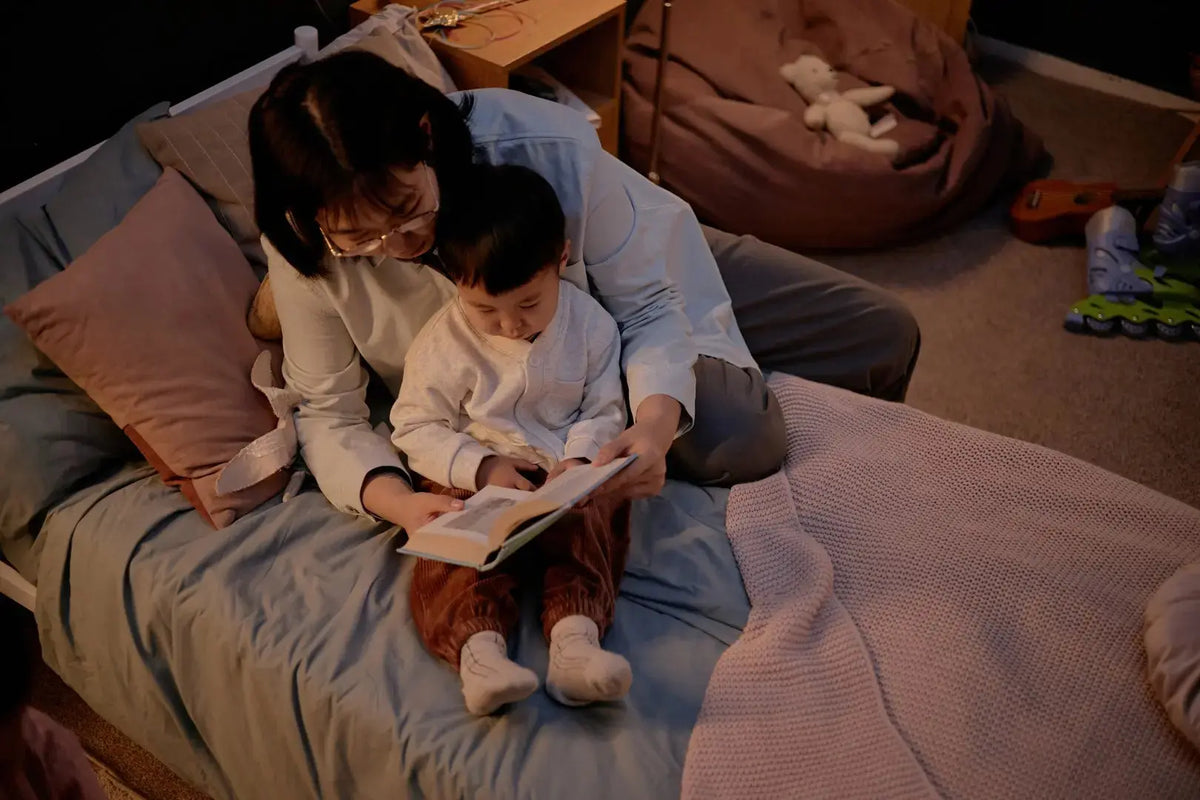
Quiet time does not need to look exactly the same in every home. For one family, it may happen after lunch. For another, it may fit into the afternoon between a busy morning and the next part of the day.
A useful quiet time routine for kids is simply a predictable pause with a clear beginning, a manageable sequence, and an equally clear ending.
The goal is not to force sleep, create a rigid timetable, or turn part of the day into another formal lesson. A quiet time routine can instead give families a calmer rhythm and a familiar part of the day that children gradually learn to recognize.
Quick answer: what is quiet time for kids?
Quiet time for kids is a planned period when the pace of the day becomes slower and expectations become simpler.
A child might look at books, draw, listen to a familiar story, explore a simple puzzle, revisit a projected lesson, or spend time with another calm and familiar option.
The important part is not the exact choice. It is the predictable rhythm around it: a transition into quiet time, a clear place to settle, a limited number of choices, and an ending that the child can understand.
Quiet time can be adapted to the age, temperament, routine, and needs of the family. It does not need to last for the same amount of time every day to be useful.
Why quiet time can become part of a family routine
Families often introduce quiet time because the day needs a natural pause. This may become especially noticeable when children drop their last nap or when a regular daytime sleep period becomes less predictable.
That does not mean quiet time is a replacement for sleep. Children have individual sleep and rest needs, and quiet time should not be treated as proof that a child is getting all the rest they need.
Instead, think of quiet time as a family routine in its own right.
It creates a predictable point in the day when the environment becomes calmer and the number of demands is reduced.
PBS recommends beginning slowly when children are new to quiet time and gradually building familiarity with the routine rather than expecting a long independent period immediately.
PBS guidance on creating a quiet time routine provides additional ideas for making the transition gradual and understandable.

Quiet time is not the same as nap time
The two routines can sit in a similar part of the day, but their expectations are different.
Nap time assumes sleep may happen. Quiet time does not require it.
If a child falls asleep naturally during a suitable rest period, families can respond according to their usual sleep routine. But the success of quiet time should not depend on whether sleep occurs.
This distinction matters because children who are moving away from a regular daytime nap may resist a routine that still feels like a demand to sleep.
A quiet-time routine can be presented more simply: this is a part of the day when things become quieter, choices become smaller, and everyone knows what happens next.
It also does not need to mean enforced alone time. Some children may be comfortable in their own quiet space, while others may initially need a parent nearby.
The routine can become more independent gradually rather than beginning with a long separation.
Create a quiet time space that feels familiar
A dedicated quiet time space does not need to be a separate room.
It might be one corner of a bedroom, a comfortable place in the living room, a reading area, or another part of the home that can remain relatively calm.
Consistency helps make the location recognizable.
If the same general space is used most days, the location itself can become part of the transition cue.
Keep the setup simple. Too many choices can turn the routine into another decision-heavy part of the day.
A few books, drawing materials, a puzzle, familiar learning resources, or one projected learning option may be enough.
Choose resources that suit the child and can be used safely within the level of supervision your family provides.

A simple four-part quiet time routine
The routine itself can be very short. What matters most is that the sequence is understandable and repeatable.
1. Use a clear transition cue
Choose something simple that signals the change of pace.
You might close the curtains slightly, tidy away the previous materials, choose a book together, lower the general noise level, or use the same short phrase each day.
The cue does not need to be elaborate. Its job is simply to say, “We are moving into a quieter part of the day now.”
2. Settle into the familiar space
Move to the usual quiet-time area and offer a small number of choices.
Children may find it easier to settle when they do not have to decide between many possibilities.
Two or three familiar options are often easier to understand than a large collection spread around the room.
3. Choose one calm, self-directed option
A self-directed choice means the child has some control over what happens within the boundaries you have already set.
For example, they might choose between looking at a book, drawing, completing a familiar puzzle, listening to a story, or exploring a short projected learning moment.
Self-directed does not need to mean completely unsupervised. It simply gives the child an appropriate amount of choice within the routine.
4. Use a clear ending cue
Children are more likely to understand quiet time when they can also understand when it ends.
A visual timer, a child-friendly clock, a familiar sound, or the same simple phrase can make the ending more concrete.
PBS specifically suggests clocks or other understandable cues for children who do not yet have a strong sense of elapsed time.

Start small when quiet time is new
If the routine is new, start small.
Expecting a child to move immediately from a busy day into a long quiet period can create unnecessary frustration.
The first version of the routine might be only a short block of time.
Once the sequence itself becomes familiar, the duration can be adjusted gradually according to what works for the family.
PBS describes a similar approach, suggesting short initial periods and gradual increases rather than starting with a long expectation.
The first goal is not duration. It is understanding the pattern.
Can the child recognize the beginning cue?
Can they settle into the usual place?
Can they choose from the available options?
Can they understand the ending cue?
Once those parts feel familiar, families can decide whether the amount of time needs to change.
What if a child keeps leaving the quiet time space?
Leaving the area does not necessarily mean the routine has failed.
It may simply mean the expectations are too large, the duration is too long, the ending is unclear, or the child does not yet understand what quiet time involves.
Return to the simplest version.
Make the period shorter.
Reduce the number of choices.
Stay nearby at first if that makes the routine easier to understand.
Use a visible ending cue so the child does not have to keep asking whether quiet time is finished.
If the child repeatedly needs support, provide it calmly rather than turning the routine into a contest over remaining in one place.
The aim is familiarity and consistency, not perfect compliance on the first few attempts.
How a visual timer can make the routine clearer
Young children do not experience five, ten, or twenty minutes in the same way an adult does.
A visual timer can make an abstract amount of time easier to see.
Choose a timer or clock that clearly shows progress toward the end without demanding constant attention.
Introduce it before quiet time starts:
“When the timer is finished, quiet time is finished too.”
Then keep that ending reasonably consistent.
The timer should clarify the routine rather than become another source of pressure.
If the child spends the whole period watching it, the duration may simply be too ambitious for now.

How much independence should quiet time include?
There is no single level of independence that every family should expect.
Some children may settle comfortably with a familiar choice while a parent works nearby. Others may prefer the parent to remain within sight for longer.
Independent quiet time can develop gradually.
Instead of making independence the first requirement, make the sequence predictable first.
Once the child knows where to go, what choices are available, and how the routine ends, the adult can decide whether to step back slightly.
This approach also keeps quiet time from becoming unwanted or confusing alone time.
A child can have some independence without being expected to manage every part of the routine alone.
What can children choose during quiet time?
Keep the choices calm, familiar, and suited to the setting.
A book can work well because the child can look through pictures, revisit a familiar story, or listen while an adult reads nearby.
Drawing gives children a simple option that does not require a complicated setup.
A familiar puzzle or sorting resource can provide a clear beginning and ending.
An audio story or gentle music may suit some family routines.
A short Ozmotic Learning projected lesson can also fit when the family wants to include a learning moment.
The exact choice matters less than maintaining the quiet-time rhythm.
If a resource consistently creates a lot of excitement or makes the transition out of quiet time harder, it may simply fit better elsewhere in the day.
Where early learning can fit naturally
Quiet time does not need to become another academic block.
Early learning can fit into it lightly.
A child might revisit familiar letters, numbers, vocabulary, a story, or another concept already introduced elsewhere.
The emphasis can stay on familiarity rather than performance.
For example, a family might spend a few minutes looking at a familiar book before the child continues independently.
Another family might use a short projected lesson and then transition into drawing or looking through books.
The learning moment should fit the quiet-time routine rather than taking it over.
Our guide to daily routines for kids explores how small repeated routines can fit naturally across the day.

How Ozmotic Learning can fit into quiet time
Ozmotic Learning uses projection-based lessons to support early skills through calm learning moments at home.
Quiet time is one setting where a short projected lesson may fit naturally.
Families might choose a familiar lesson around letters, numbers, language, science, or another early-learning topic and use it as one part of the wider routine.
The purpose is not to fill the whole quiet period with instruction.
A short guided learning experience can sit alongside books, drawing, conversation, or another calm option.
That keeps Ozmotic Learning secondary to the family's routine rather than making the routine depend on the product.
Families can explore Ozmotic Learning to see how projection-based lessons can fit into learning-at-home routines.
Quiet time does not have to happen at the same time every day
Consistency is useful, but consistency does not require an identical clock time.
Some families may find that quiet time works best shortly after lunch.
Others may use it later in the afternoon or whenever the day's schedule naturally becomes less busy.
If timing varies, keep the sequence recognizable.
Use a similar transition cue.
Use the same general quiet time space.
Keep the number of choices manageable.
Use the same type of ending cue.
The routine can remain recognizable even when the clock changes.
Why quiet time does not need to be perfect
There will be days when a child settles easily and days when they do not.
A family routine should be flexible enough to accommodate that difference.
The routine may also need to change as children grow, schedules change, siblings have different needs, or the household rhythm shifts.
If quiet time regularly creates conflict, simplify it.
If it feels too long, shorten it.
If the choices are distracting, reduce them.
If the child needs more connection before settling, build that connection into the transition.
The useful question is not, “Did we do quiet time perfectly?”
It is, “Is this becoming a recognizable, manageable pause in our family day?”

A quiet time routine can stay simple
The most sustainable quiet time routine for kids is often the one that families can repeat without a large amount of preparation.
Use a clear start cue.
Move to a familiar place.
Offer a small number of calm choices.
Give the child an appropriate amount of self-directed choice.
Use a clear ending cue.
Then adjust the length and level of independence as the routine becomes more familiar.
Families may benefit from quiet time most when it is treated as a flexible part of the day rather than another standard children are expected to meet.
If your family is building a wider learning-at-home rhythm, you can also explore our guides to personalized learning at home and a flexible kindergarten homeschool schedule.
The goal is not a perfect hour of silence. It is a repeatable family rhythm that makes room for a calmer pace, familiar choices, and learning moments that fit naturally into home life.
Share:
Science Experiments for Preschoolers: Simple Ways to Observe, Predict, and Test
How to Help Kids Remember What They Learn: Simple Ways to Revisit Ideas