
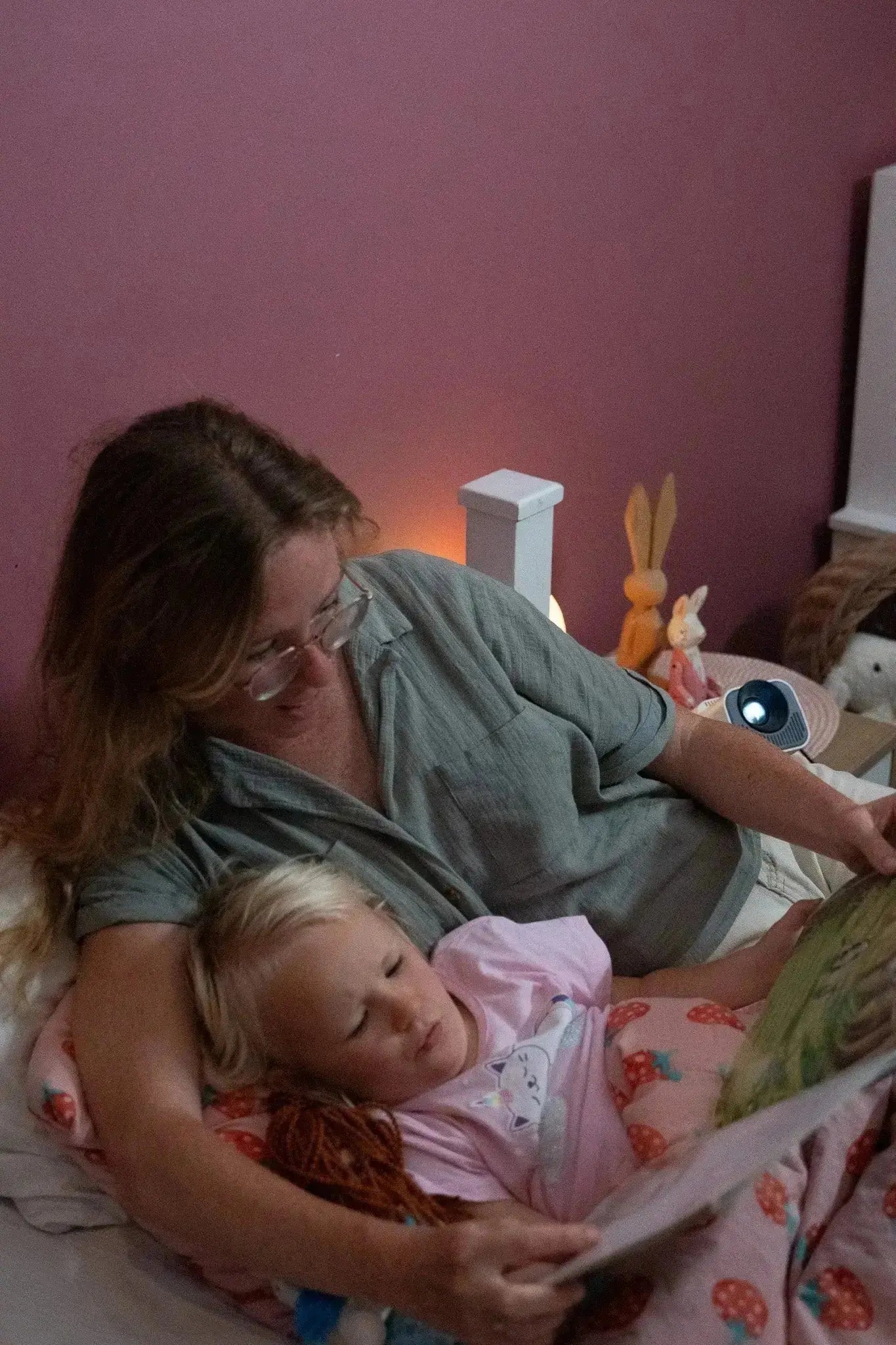
Bedtime resistance in children can show up in many small ways: another drink, another question, leaving the bedroom, asking for one more story, or simply saying they are not ready when it is time for bed. These bedtime struggles can be tiring for the whole family, especially when the pattern repeats night after night.
Quick answer: Bedtime resistance is not always about one particular behavior. It often describes repeated delays or pushback around the transition to bed. A calm, consistent routine can make the sequence easier to understand, while giving parents a familiar plan to return to when evenings feel unpredictable.
What is bedtime resistance in children?
Bedtime resistance is a broad term used for behaviors that delay or interrupt the process of going to bed.
A child may:
- ask for repeated drinks, hugs, or questions
- delay brushing teeth or getting into pajamas
- leave the bedroom after being tucked in
- say they are not tired
- ask to restart part of the bedtime routine
- find it difficult to stay in bed once the routine is finished
These bedtime problems can happen occasionally in many families. They become more noticeable when the same pattern begins to shape most evenings.

What research says about bedtime resistance and routines
The study Bedtime Routines of Young Children, Parenting Stress, and Bedtime Resistance: Mediation Models examined relationships between parenting stress, bedtime routine consistency, and bedtime-resistant behavior.
The researchers found a bidirectional pattern. Higher parenting stress was associated with less consistent bedtime routines, and less consistent routines were associated with greater bedtime resistance. Bedtime resistance was also associated with higher parenting stress.
That does not mean an inconsistent routine directly causes every case of bedtime resistance, or that simply changing the routine will solve it. The study does suggest that family stress, routine consistency, and bedtime behavior can interact with one another.
Why bedtime struggles can become a repeating cycle
When an evening has been difficult, parents may naturally shorten, change, or negotiate the routine because everyone is tired.
The next evening may then look different again.
That can make bedtime harder to predict for both parent and child. More requests may follow, which can make the evening feel even more tiring.
A consistent routine gives the family something familiar to return to. It does not need to be strict or identical every night. The main benefit is simply that the order is recognizable.
What can a consistent bedtime routine look like?
A bedtime routine does not need many steps. Start with the things that already need to happen, then add a short wind-down time and a recognizable ending.
| Step | What it might look like |
|---|---|
| 1. Signal that bedtime is beginning | Use the same simple phrase or transition each evening. |
| 2. Get ready | Wash, pajamas, bathroom, and brushing teeth. |
| 3. Share a quiet moment | A short conversation, cuddle, prayer, or familiar family moment. |
| 4. Read or revisit something familiar | A book, story, or another calm part of the routine. |
| 5. Finish clearly | Use the same goodnight phrase or closing sequence. |
For a fuller example, see our guide to bedtime routines for kids.
How to put your child to bed without making every step negotiable
When parents are trying to put a child to bed, it is easy for small decisions to multiply.
Which pajamas? Which book? Another drink? A different song? One more question?
Limited choices can give children some participation while keeping the overall sequence clear.
For example:
- “Would you like the blue pajamas or the striped pajamas?”
- “Which of these two books should we read?”
- “Would you like our song before or after the story?”
Both choices still move the routine toward the same ending.
What to do when your child keeps getting out of bed
Some bedtime resistance happens after the routine appears to be finished.
A child may get out of bed for another question, another drink, or another check-in.
It can help to make the closing sequence easy to recognize before that point arrives. Have water ready if needed, agree on the final book, and use the same simple goodnight phrase.
If your child gets up again, keep the response calm and brief rather than reopening the full routine.
The aim is not to turn staying in bed into a contest. It is to keep the boundary of the routine understandable.

What if your child says they are not ready for bed?
Children do not always feel tired at the exact moment the family schedule says it is time for bed.
A familiar wind-down can help separate the start of the bedtime routine from the expectation that a child will immediately fall asleep.
For example, the routine might begin with getting ready, followed by reading and a quiet family moment before the final goodnight.
If the pattern regularly feels mismatched with when your child is ready for sleep, it may be useful to look at the wider daily schedule rather than simply adding more steps to bedtime.
Can separation anxiety affect bedtime?
For some children, bedtime resistance may happen alongside separation anxiety or difficulty with the transition away from a parent or caregiver.
In that situation, a predictable ending can be especially useful because the child knows what will happen next.
That might include the same final cuddle, phrase, song, or short check-in.
Separation anxiety can vary widely between children. If it is intense, persistent, or significantly affecting family life, individual guidance from a pediatrician or another qualified professional may be appropriate.
A shorter routine for difficult evenings
Some nights simply have less room for a long routine. Dinner ran late, everyone is tired, or the evening changed unexpectedly.
Instead of abandoning the bedtime routine completely, keep a shorter version available.
- Get ready: wash, pajamas, teeth.
- Reconnect: one short quiet moment together.
- Read: choose one short story or familiar book.
- Close: use the normal goodnight phrase.
The routine is shorter, but the broad order stays recognizable.
This can be especially useful for families who find that bedtime struggles increase when the evening becomes rushed or unpredictable.
Where can a calm learning moment fit?
Some families include a short learning moment before the final wind-down.
If it already fits naturally into your family routine, keep it brief and familiar rather than adding another formal lesson to the evening.
The Ozmotic Learning projection-based learning tool uses wall or ceiling projection to support guided learning moments across letters, numbers, stories, languages, science, and other early learning subjects.
A projection-based lesson can sit within the earlier part of the evening routine where it suits the family, followed by reading, conversation, or another quiet step before goodnight.
For broader guidance on sleep and family routines, see our sleep and child development guide.

When bedtime resistance may need more support
Bedtime resistance is different from a diagnosed sleep disorder.
Families should consider speaking with a pediatrician or qualified sleep professional when sleep concerns are persistent or severe, particularly if there is regular snoring, unusual breathing during sleep, frequent night waking, significant daytime sleepiness, or another concern that goes beyond ordinary bedtime delays.
A professional can also help when parents are unsure whether repeated bedtime problems are part of the routine, related to anxiety, or connected with another sleep concern.
Bedtime resistance in children: what to remember
Bedtime resistance in children can make evenings feel longer than anyone intended, but the answer does not have to be a more complicated bedtime plan.
Start with a routine that is clear enough to recognize and realistic enough to repeat. Use limited choices, keep the final steps familiar, and have a shorter version available for difficult evenings.
Some bedtime struggles will still happen. A consistent routine simply gives the family a dependable place to return to when they do.
Share:
Phonics-Based Instruction: A Parent Guide to Early Reading
Sleep and Child Development: What Parents Should Know