
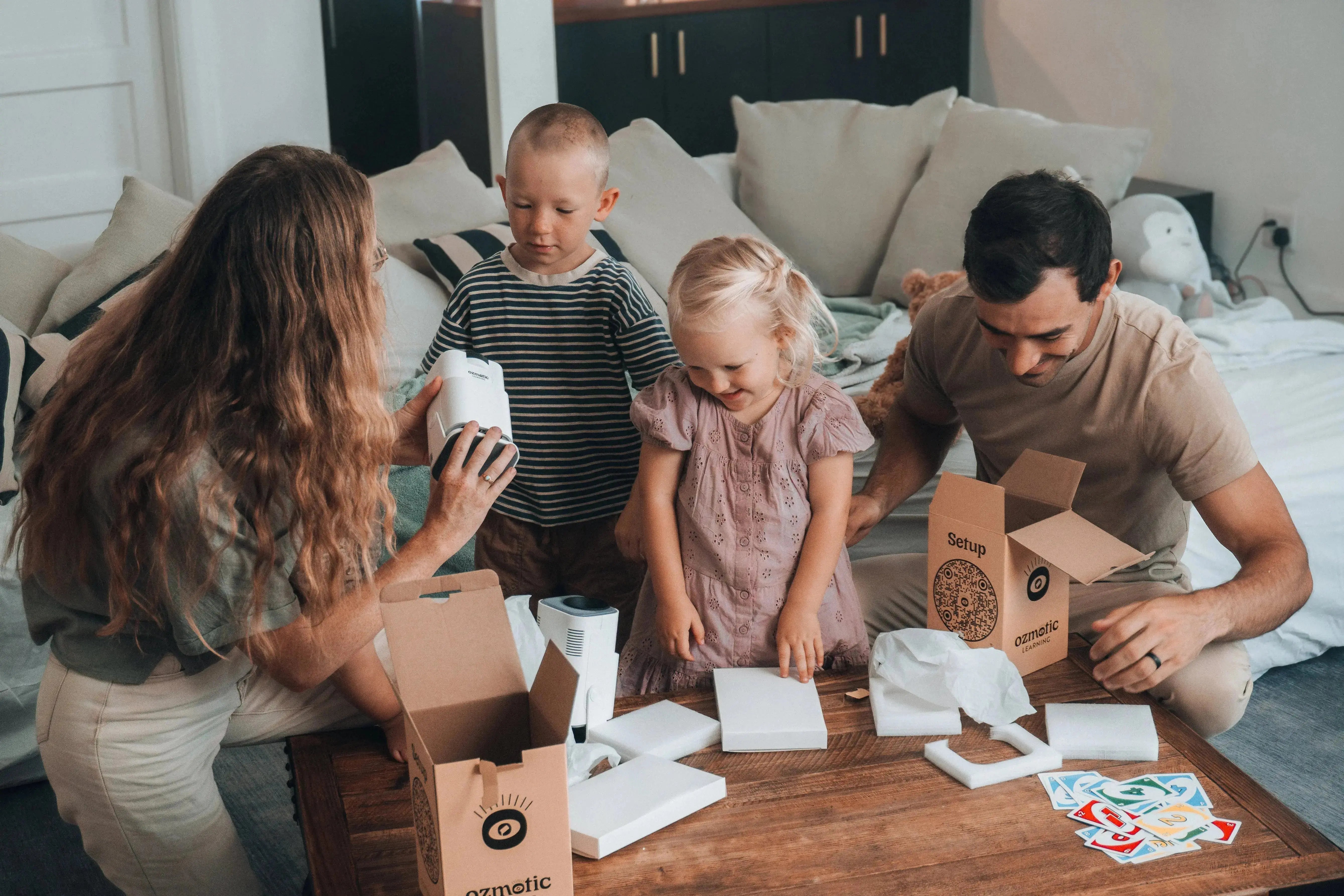
Toddler language development at home often grows through ordinary conversation. Naming what you see, reading together, repeating familiar words, and giving a child time to respond can all create useful opportunities for language learning without turning the day into a formal lesson.
Quick answer: Families can support toddler language development at home by talking often, repeating useful words, reading together, using simple sentences, asking open-ended questions, and creating a language-rich environment during familiar daily routines.
What does toddler language development at home look like?
Young children learn to communicate through many small exchanges. They hear words, connect them with people and objects, try sounds themselves, and gradually begin to use language in more ways.
That means language learning does not need to happen during a special lesson. It can happen while getting dressed, eating together, choosing a book, preparing for bed, or talking about something that has caught a child’s attention.
Parents do not need to fill every quiet moment with questions either. Sometimes simply describing what is happening gives a child useful language to hear.
| Everyday moment | What you might say | Language focus |
|---|---|---|
| Getting dressed | “Blue shirt. Your blue shirt is soft.” | Describing words |
| Mealtime | “You have two strawberries.” | Numbers and familiar objects |
| Reading together | “Where is the dog going?” | Vocabulary and conversation |
| Evening routine | “First pajamas, then our story.” | Sequence words |

Create a language-rich environment through conversation
A language-rich environment is not about using complicated vocabulary all day. It simply means giving children regular opportunities to hear meaningful words connected with what they are seeing, doing, and thinking about.
For example, instead of saying only “Shoes,” you might say, “Here are your shoes. Let’s put your shoes on.” The repeated word stays connected to the object and the moment.
These small exchanges can help children hear how words fit together while giving them time to respond in their own way.
Use simple language children can hear and respond to
Parents naturally adjust the way they speak depending on the situation. With young children, short and clear sentences can make it easier to follow the conversation.
You can build on a child’s words without correcting every attempt.
For example:
- Child: “Dog.”
- Parent: “Yes, a big dog.”
Or:
- Child: “Car go.”
- Parent: “The car is going fast.”
This adds a little more language while keeping the conversation connected to what the child already wanted to say.
Try parallel talk during daily routines
Parallel talk means describing what a child is doing while they are doing it.
If your child is putting blocks into a box, you might say:
“You picked up the red block. Now it goes in the box. Another block is going in.”
You are not asking the child to perform or answer. You are simply adding language to something that already has their attention.
This can be especially easy to use during familiar daily routines because the words naturally connect with what is happening.

Why reading together matters for language learning
Reading together creates a natural reason to name objects, hear new words, talk about pictures, and return to familiar phrases.
You do not need to read every word exactly as it appears on the page. If a child points to something interesting, pause and talk about it.
You might say:
- “That bird is yellow.”
- “Where do you think it is going?”
- “Can you find another bird?”
- “What happened next?”
The NHS recommends talking with young children throughout the day, repeating what they say, adding to their sentences, and sharing books together. You can explore its tips for chatting and building sentences.
Use open-ended questions without turning conversation into a quiz
Open-ended questions can encourage children to use language in their own way, but too many questions in a row can make a conversation feel like a test.
Instead of asking question after question, mix comments and questions together.
For example:
“The bear is carrying a basket. I wonder where it is going. What do you think?”
That gives the child more context than simply asking, “Where is the bear going?”
If the child does not answer, continue the conversation naturally. Language development is not measured by whether every question gets a response.
Give children time to express themselves
Children may need a little extra time to find a word, make a sound, point, gesture, or put a sentence together.
After you say something or ask a question, try leaving a short pause before jumping in with another prompt.
A child can express themselves in different ways while language is developing. Gestures, facial expressions, pointing, sounds, and words can all be part of a conversation.
The aim is not to rush a child toward longer sentences. It is to create space for communication to happen.
How repetition can support language skills
Young children often encounter the same useful words many times before those words become familiar.
You might use the word “apple” at breakfast, see an apple in a book later, and notice another one during a learning moment. Each encounter gives the word another context.
This is where repetition can support broader language skills without becoming repetitive drilling.
Families interested in this approach can also explore our guide to learning through repetition.
What about speech and language development?
Speech and language development is a broad area. Speech usually refers to how sounds and words are produced, while language includes understanding and using words, sentences, and meaning.
Parents may notice children developing these skills at different rates and in different ways.
The ideas in this article are general ways to encourage conversation and use language during family life. They are not a substitute for professional guidance if a parent has concerns about a child’s speech or communication development.
Where Ozmotic Learning can fit
Projection-based lessons can give families another starting point for conversation.
A child may see an animal, letter, number, story scene, or familiar object projected onto a wall or ceiling. A parent can then name it, describe it, repeat a useful word, or ask one simple question.

The Ozmotic Learning projection-based learning tool includes lessons across letters, stories, languages, numbers, science, and other early learning subjects.
Families can explore the Ozmotic Learning content library to find subjects that naturally invite naming, describing, repeating, and conversation.
The projection provides the starting point. The conversation around it is what makes the moment personal to the family.
A simple language routine to try at home
You do not need a complicated plan to support language development. Try a short sequence like this:
- Notice: choose one thing your child is already looking at or interested in.
- Name: give it a simple word or phrase.
- Add: expand the word into a short sentence.
- Pause: give your child time to respond.
- Repeat later: return to the word naturally during another part of the day.
For example:
“Bird.”
“A blue bird.”
“The blue bird is flying.”
Then pause and see where the conversation goes.
Simple ways to support language development at home
- Talk about what your child is already noticing.
- Use short, clear sentences.
- Repeat useful words in different contexts.
- Read together regularly.
- Use parallel talk during familiar routines.
- Mix comments with open-ended questions.
- Give children time to respond.
- Add one or two words to what your child already says.

Final thoughts
Toddler language development at home is built through many small moments of communication. A conversation over breakfast, a shared book, a familiar word repeated during the day, or a short exchange around a projected lesson can all create opportunities to hear and use language.
The goal is not to fill every moment with teaching. Talk, listen, pause, and give your child room to take part.
Those everyday exchanges can help create a language-rich environment that feels like a natural part of family life.
Share:
Interest-Based Learning for Kids: Build on Curiosity at Home
Early Childhood Neuroplasticity: Why Ages 1 to 5 Matter Most