
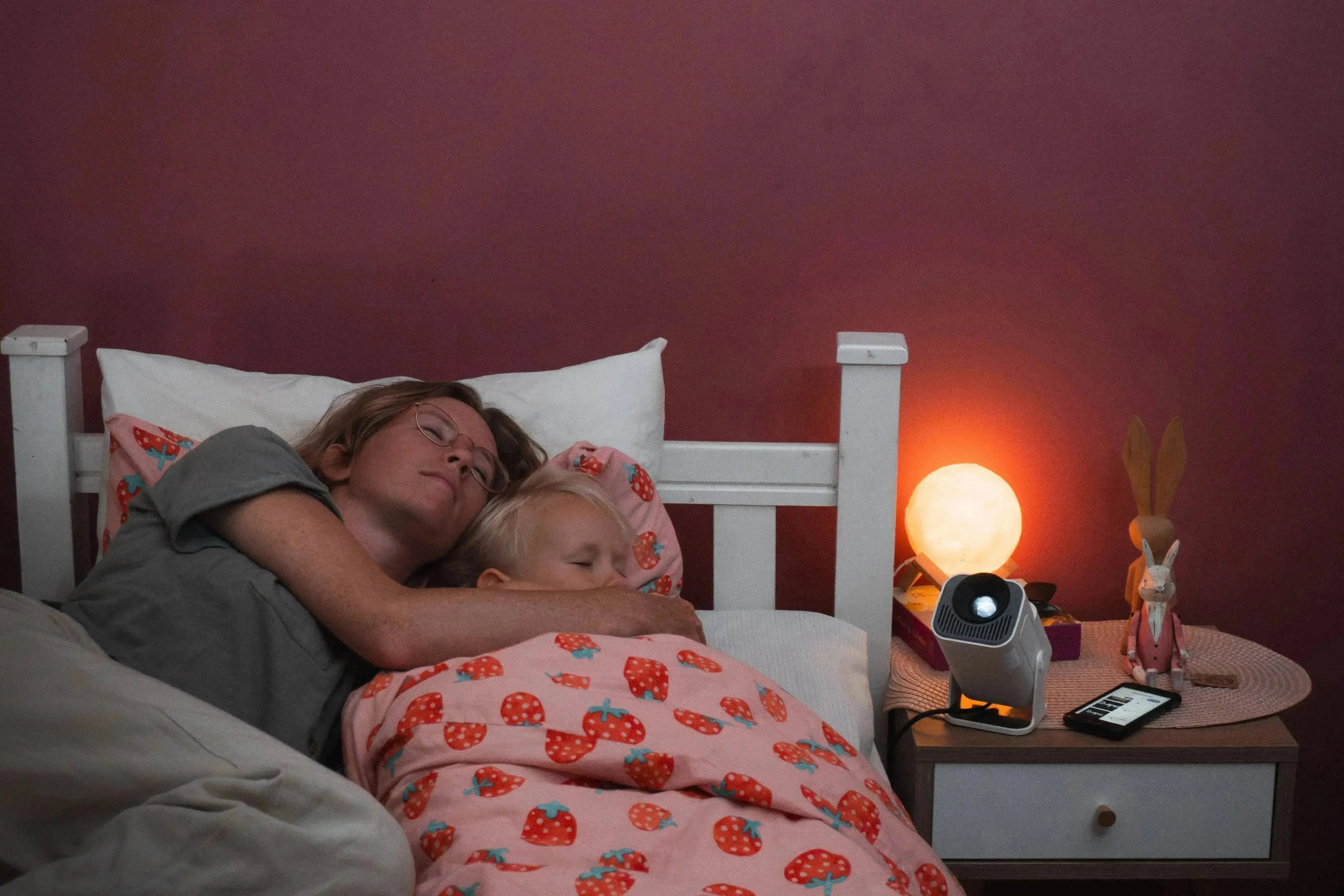
Can kids learn while sleeping? Not in the usual sense of learning a brand-new lesson while asleep. Research does suggest that sleep can be involved in what happens to memories after learning has already taken place, but that is different from teaching new information to a sleeping child.
Quick answer: Children should not be expected to learn new lessons while they sleep. Research on sleep, learning and memory is more focused on how the brain processes information that was first encountered while awake. Some laboratory studies have also explored whether cues presented during sleep can reactivate previously learned material.
Can kids learn while sleeping?
The idea that someone can simply learn in your sleep is appealing, but it oversimplifies what sleep research actually shows.
Learning normally begins while a person is awake. A child hears a word, sees a letter, explores a number concept, listens to a story, or encounters another new idea.
Sleep then becomes relevant because researchers study what happens to those recently formed memories afterward.
This process is often discussed as memory consolidation.

Learning while awake is different from memory processing during sleep
There are two ideas that are easy to confuse:
| Idea | What it means |
|---|---|
| Learning while awake | Encountering, understanding, or practicing new information while conscious |
| Memory processing during sleep | Processes that may help stabilize or reorganize information encountered earlier |
The second does not replace the first.
The sleeping brain is active in many ways, but that does not mean a sleeping child is having the same kind of guided learning experience they would have while awake.
What the University of Utah study actually tested
A University of Utah Health research summary describes a study in which 24 healthy adults between 18 and 27 years old learned two piano tasks while awake.
Each task was associated with an auditory cue. After learning the tasks, participants took a nap while researchers played either sounds connected with the earlier learning or unrelated sounds.
The researchers then examined brain activity and tested performance again after the nap.
Participants performed better on the material associated with the cues presented during sleep. The researchers interpreted this as evidence of targeted memory reactivation, where a cue linked to something already learned may reactivate that memory during sleep.
You can read the University of Utah Health summary here: New Research Shows How to Boost Memory During Sleep.
The important limitation for this article is straightforward: the participants were adults, and they learned the material before going to sleep. The study did not show children learning completely new educational content while asleep.
What is targeted memory reactivation?
Targeted memory reactivation, often shortened to TMR, is an experimental method used to study memory during sleep.
The basic sequence looks like this:
- A person learns something while awake.
- A particular sound or other cue is associated with that learning.
- The person goes to sleep.
- Researchers present the associated cue during a particular sleep stage.
- Memory for the previously learned information is tested later.
This is very different from playing an unfamiliar lesson to someone who has never encountered the material before.
What broader research says about sleep and memory
A meta-analysis of targeted memory reactivation research combined results from 91 experiments involving 2,004 participants.
The researchers found that TMR could influence memory performance when cues associated with earlier learning were presented during non-REM sleep. Effects were reported across several kinds of memory, including declarative information and skill learning.
You can read the review here: Promoting Memory Consolidation During Sleep: A Meta-Analysis of Targeted Memory Reactivation.
Importantly, the authors also note that whether these laboratory findings translate into meaningful educational applications still needs further research.
What is slow-wave sleep?
Slow-wave sleep is a stage of non-REM sleep characterized by particular patterns of brain activity.
It is one of the sleep stages researchers examine when studying learning and memory because memory reactivation and consolidation processes have been observed during non-REM sleep.
In the targeted-memory-reactivation meta-analysis, effects were found during both stage 2 non-REM sleep and slow-wave sleep.
That does not mean parents need to identify a child's sleep stages or try to time learning cues at home. The research involves controlled laboratory methods and specialized measurement.

Can children learn completely new information during sleep?
The evidence discussed here does not show that a child can be taught a new phonics sound, vocabulary word, mathematics concept, or science lesson simply by presenting it during sleep.
Research on targeted memory reactivation begins with information that has already been learned while awake.
That distinction matters because phrases such as “sleep learning” can suggest something much stronger than the evidence supports.
A more accurate way to describe the research is:
Sleep may participate in the processing and consolidation of memories formed during earlier waking learning.
That is different from saying children can learn new lessons while asleep.
Does sleep strengthen everything learned during the day?
Not automatically.
Memory is complex. What gets retained can depend on the type of information, how well it was initially learned, repetition, later experiences, sleep patterns, individual differences, and many other factors.
Research into memory consolidation helps scientists understand these processes, but it does not provide a guarantee that any specific lesson will become long-term memory simply because sleep follows it.
For a broader explanation, see our guide to sleep and memory in children.
What about learning something before sleep?
Learning before sleep is another related but separate question.
Researchers have examined whether the timing of learning relative to nighttime sleep influences later memory. Results can differ depending on the type of learning being tested.
Our learning before sleep for kids article looks specifically at that question.
The important point is that both topics begin with learning while awake.
What parents can reasonably take from the research
Families do not need laboratory sleep techniques to make use of the broader learning principles.
A more practical approach is:
- introduce new ideas while your child is awake
- keep learning moments manageable
- return to useful ideas over time
- use repetition without expecting instant mastery
- protect the family's normal sleep routine
- avoid treating bedtime as another performance goal
If an evening learning moment fits naturally into family life, it can remain calm and brief. If the child is tired or the evening is already full, there is no reason to force additional learning before bed.
Where Ozmotic Learning fits
Ozmotic Learning is designed for guided, projection-based learning while children are awake.
The Ozmotic Learning projection-based learning tool uses wall or ceiling projection for lessons across letters, numbers, phonics, stories, languages, science, and other early learning subjects.

Families can browse the Ozmotic Learning content library and revisit lessons across different learning moments.
For more about the research and thinking behind Ozmotic Learning, visit our Science page.
Ozmotic Learning should not be understood as technology that teaches children while they sleep. The learning experience happens while the child is awake and participating.
Can kids learn while sleeping? The bottom line
So, can kids learn while sleeping?
Not in the ordinary sense of being taught completely new educational material during sleep.
What research does show is that the sleeping brain remains involved in processes connected with previously formed memories. Laboratory research on targeted memory reactivation suggests that cues linked with earlier waking learning can influence memory processing during certain stages of sleep.
That is fascinating science, but it should not be turned into a promise that children can simply learn in their sleep.
The most grounded approach remains much simpler: let learning happen while children are awake, revisit useful ideas over time, and allow sleep to remain sleep.
Share:
Educational Bedtime Routine for Toddlers: Calm Learning That Fits Your Family Rhythm
Learning Before Sleep for Kids: What Research Actually Says